


Event

2026/2/27(Fri) 11:00~17:00
Held a science idea-thon event to create startups that utilize the technological seeds of the GTIE Tsukuba site!
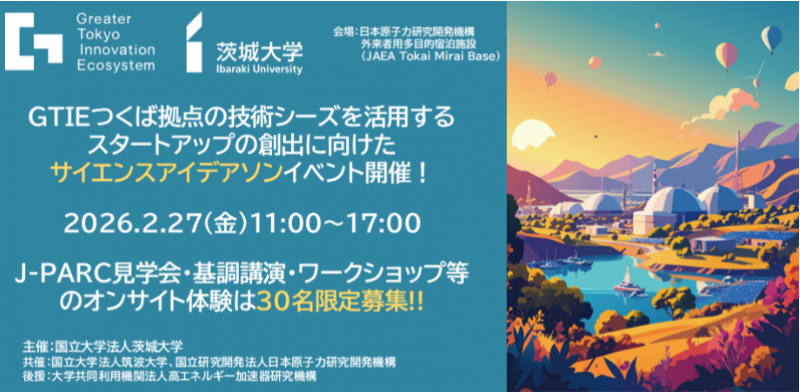
In last year’s Science Idea-thon, we discussed how to link research results to social implementation and startups, using the cutting-edge technology of nuclear fusion research in the energy field as a starting point. In the process, it became clear that while research is becoming more advanced, there are diverse structural issues that need to be addressed before it can be commercialized. In this session, we will go back to the very site of research activities in the nuclear energy field itself and discuss the technologies, knowledge, and research environment accumulated there on a daily basis as a starting point. We will discuss how the results of nuclear research, including neutron beam applications and fusion, can be connected to society, and what kind of social implementation and business development is possible with the involvement of researchers themselves, from various perspectives, and share perspectives that will lead to the next innovation.
[Program of the day (tentative) ] *Please note that the time of the speakers may be subject to change depending on their availability. 11:00- Registration (for J-PARC visitors only) 11:10~12:10 Tour of J-PARC 12:30~ Doors open 13:00~13:05 Opening remarksShigeru Kuramoto, Vice President, Ibaraki University 13:05-13:50 Keynote Speech (1) “Revival of Science – Renewal of Research Infrastructure, J-PARCDr. Daisuke Baba, Counselor (Research Environment), Science and Technology Policy Bureau, Ministry of Education, Culture, Sports, Science and Technology 13:50~14:05 Keynote Speech 2 “Tokai Village Industrial Promotion Vision (tentative)Industry Department, Tokai Village, Ibaraki Prefecture 14:05 – 14:20 Break 14:20-16:55 Workshop -Case Study Pitches Landsview Inc. Advanced Float Corporation (by Mr. Okada of Mirai Creative Investments) -Workshop Theme Theme 1: Where should start-ups enter in the nuclear field, a regulated industry? Theme 2: Which market is the fastest to value the “by-product technology” of nuclear R&D? Theme 3: What are the possibilities of social implementation from the utilization of J-PARC facilities and research environment? 16:55-17:00 Closing remarksYoshitaka Nishino, Councilor/Professor, International Industry-University Collaboration Division, University of Tsukuba
*The Greater Tokyo Innovation Ecosystem (GTIE) is a platform for “fostering university-launched startups that change the world” centered on universities in the Tokyo metropolitan area, GTIE brings together universities, local governments, VCs, CVCs, accelerators, and private companies in the Tokyo metropolitan area to create university-launched startups and provide entrepreneurship education.
[Speakers ]<Keynote Speech 1Mr. Daisuke Baba, Counsellor (Research Environment), Science and Technology Policy Bureau, Ministry of Education, Culture, Sports, Science and Technology (MEXT) Mr. Baba joined the Ministry of Education, Culture, Sports, Science and Technology (MEXT) in 2004. He served as Director of the Office of Basic Research Promotion, Director of the Office of University Research Enhancement, and First Secretary at the Embassy of Japan in the United States. In his current position from July 2025, he has been promoting the renewal of research infrastructures at J-PARC and other specified advanced large-scale research facilities and research universities in Japan. He holds a Master of Science, Master of Public Policy, STPP from the University of Michigan, and EMP from the University of Tokyo. He is a member of the editorial board of the Chemical Society of Japan.
<Keynote Speech 2Department of Industry, Tokai Village, Ibaraki Prefecture
<Workshop – ModeratorDr. Munetoshi Sakai, Professor, Research and Industry-Academia Collaboration Organization, Ibaraki University D. in Geosciences from the University of Tsukuba in 2004, he has been involved in the “intellectual property management and research strategy formulation” in the flow research and NEDO projects he has participated in at KAST, and has been involved in the “launch customer model”, which has enabled him to transfer research results in the “mechanical” and “materials and chemistry” fields, starting from the basic research stage, to the “technology transfer” stage. In recent years, the company has been working with the University of Tsukuba on the development of a new research strategy. In recent years, the company has been fostering world-class researchers through “TRiSTAR,” a program for fostering top runners through collaboration among universities, national research institutes, and companies, which is jointly implemented with the University of Tsukuba, as well as through the “Greater Tokyo Innovation Ecosystem (GTIE),” an organization led by the University of Tokyo, Waseda University, and Tokyo Institute of Technology, which is creating SUs. (GTIE), which is led by the University of Tokyo, Waseda University, and Tokyo Institute of Technology, as co-chairs of the program.
<Workshop – Pitch SpeakersTeam Director, Neutron Beam Technology Development Team, RIKEN Photon Research CenterMs. Yoshie Otake, President, Neutron Next Generation System Technology Research Association T-RANS (approved by the Minister of Land, Infrastructure, Transport and Tourism) Ms. Otake is currently the Chief Technical Advisor of Landsview, a RIKEN startup established in 2023, and has served as the President of the Neutron Science Society of Japan since 2023 and as the Vice President of the Neutron Industrial Application Promotion Council since July 2025. Since around 2009, he has been involved in the establishment of a project at RIKEN to develop a “field-useable neutron device” as a non-destructive measurement device to meet the needs of the industry, and since 2013 he has been working in his current position in the Neutron Beam Technology Development Team, developing the accelerator-based RIKEN compact neutron source system RANS project. In 2013, he joined the RIKEN Neutron Beam Technology Development Team, where he has been developing the RANS project, a compact accelerator-based neutron source system. From the beginning, he has been working to develop a compact neutron source system that can be used at manufacturing sites and social infrastructure sites, especially bridges. In particular, the company has begun to explore the direction in which a start-up business can be established by, for example, participating in a pitch contest for social implementation along with the practical development of RANS-μ, which began to be developed around 2019. RIKEN, companies and T-RANS RIKEN, companies, and T-RANS collaborated to successfully develop RANS-μ, the world’s first neutron salinometer (RANS-μ), which was published in the Ministry of Land, Infrastructure, Transport, and Tourism catalog, and at the same time, a start-up company was established. RANS-μ technology was awarded the Minister of Land, Infrastructure, Transport and Tourism Award in 2024. RANS-μ is currently developing the accelerator-based RANS-III (trailer-mounted type) for non-destructive inspection of actual bridges, and at the same time, RANS-μ is being implemented in society as a measurement service business by Landsview Inc. The company is currently focusing on how to take a big step into the start-up phase.
Mr. Hiroyuki Okada, President, Mirai Sozo Investments Co. Mr. Okada joined the Tokyo Electric Power Company (TEPCO) in 1996 after completing a master’s degree at the Tokyo Institute of Technology. He was engaged in the introduction of new technologies, energy policy planning, research and development of advanced technologies, and joint research with universities in the Nuclear Energy Division. After being seconded to a VC firm, Mr. Yuriyuki gained a wide range of experience from advanced technology to business management, including LP investment/management, business investment, and M&A execution for the Innovation Network Corporation of Japan, JAFCO, UTEC, and other firms. He is an advisor to the Open Innovation Office of Tokyo University of Science, a guest professor at Japan Advanced Institute of Science and Technology, and an advisor to the City of Kitakyushu.
[ Event Summary ]
Date and Time Friday, February 27, 2026, 11:00-17:00Place of the event Japan Atomic Energy Agency Multipurpose Accommodation for Visitors (JAEA Tokai Mirai Base) 3-7-25, Higashi-3-chome, Tokai-mura, Naka-gun, Ibaraki, Japan
h ttps:// is.j-parc.jp/uo/ja/MiraiBase.pdf *6 minutes walk from JR Tokai station
Participation fee
Free
Capacity:
On-site (tour, keynote speeches, workshops): 30 people
*Online viewing (plenary presentations of keynote speeches and workshops) is also available.
Expected participants
・ Researchers with technology seeds (engineers, venture companies (seed/early stage), etc.)
Startup supporters from universities and research institutes (industry-industry-university relations, etc.) Incubators such as VC and CVC (accelerators, venture companies (middle and later stage), etc.) *Startups related to nuclear fusion, the most advanced energy-related research, are encouraged to attend.Format On-site + Online *Participation in the workshop is mandatory for “On-site” ticket holders. *On-line ticket holders may only attend the keynote speeches and plenary presentations of the workshop. *Online link will be sent to “Online Viewing” ticket holders.Organizer Ibaraki UniversityCo-organizer University of Tsukuba (pending) Japan Atomic Energy AgencySupported by High Energy Accelerator Research Organization (KEK)Disclaimer Please refrain from taking video or recording during the lecture.For inquiries, please contact Science Idea-thon Management Office [ in GTIE Office, Ibaraki University ] Science Idea-thon Management Office Administrative trustee: Deloitte Touche Tohmatsu LLC Contact person: Ono, Ibaraki, Funaki Mail: ibaraki_science_ideathon@tohmatsu.co.jp Reception/Response Hours: 10:00 – 17:00 (except Saturdays, Sundays, and holidays)
Contact for application
h ttps:// ibaraki-univ-science-ideathon-2025.peatix.com/view