


Entrepreneurial Support Program(Explore Course)


- Principal Investigator
-
Institute of Science Tokyo
Shoen Kume
- Adopted Theme
The commercialization of n-Encap iβ: A Novel Diabetes Treatment Using iPS Cell-Derived β Cells Encapsulated in an Immuno-Isolation Device.
- Subject of Research
- The commercialization of n-Encap iβ: A Novel Diabetes Treatment Using iPS Cell-Derived β Cells Encapsulated in an Immuno-Isolation Device.
- GTIE VC Collective
Mitsubishi UFJ Capital Co., Ltd.
- Overview
-
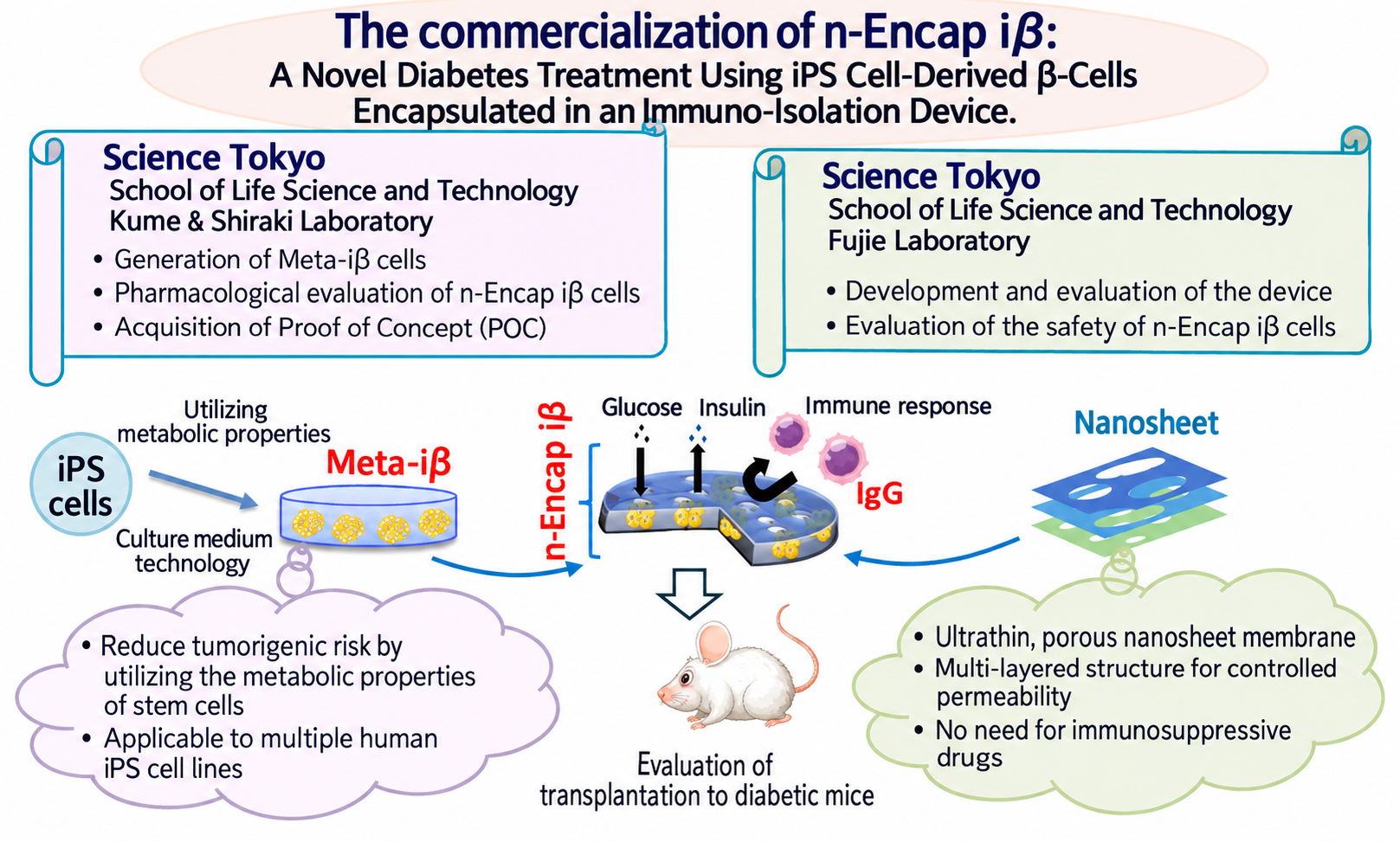
This project aims to integrate the following two technologies to develop a novel cell therapy for diabetes that does not require immunosuppressive drugs and to establish a startup company that will drive its commercialization.
The first technology is a differentiation method for generating iPS cell (iPSC)-derived ꞵ cells (Meta-iꞵ) with glucose responsiveness and insulin secretory capacity comparable to those of healthy human pancreatic islets (Kume–Shiraki Laboratory, School of Life Science and Technology, Institute of Science Tokyo). The second is an ultrathin-membrane fabrication technology that enables highly efficient insulin permeation from the inside to the outside while preventing IgG from entering (Fujie Laboratory, School of Life Science and Technology, Institute of Science Tokyo).
By integrating these technologies, we will develop a NanoSheet device-encapsulated iPSC-derived ꞵ cells (n-Encap iꞵ), in which Meta-iꞵ cells are encapsulated within a device covered with the thin membrane described above. We will then evaluate the therapeutic efficacy and safety of n-Encap iꞵ and advance toward clinical application as a novel cell therapy for diabetes that eliminates the need for immunosuppressive drugs.
- Business Models(when applying)
Islet transplantation is a treatment option available to avoid the risk of severe hypoglycemia associated with diabetes management; it has been covered by health insurance in Japan since 2020. However, challenges such as a shortage of donor pancreases, the burden of immunosuppressant use, and declining function over time have prevented it from becoming a widely adopted treatment. Therefore, through n-Encap iβ, the aim is to realize a contribution to society by providing a safe and accessible new treatment option for patients such as those who are insulin-dependent and at high risk of sudden death from hypoglycemia.
- Activity Planning(when applying)
We will establish PoC for n-Encap iβ that is robust enough to support a commercialization decision; this involves demonstrating the device's immune-isolation capabilities in animals with healthy immune systems while confirming the ability to produce Meta-iβ from clinical-grade-iPSCs that functions equivalently to that from research-grade iPSCs. We will also assess the adequacy of non-clinical testing requirements for n-Encap iβ (including through preliminary consultations with the PMDA) and develop a concrete action plan for the next phase.
Additionally, we will define the personnel requirements needed to complement our existing capabilities, specifically for business development management, fundraising and capital management, and capital policy planning, and drive recruitment efforts in preparation for establishing the corporate entity.